

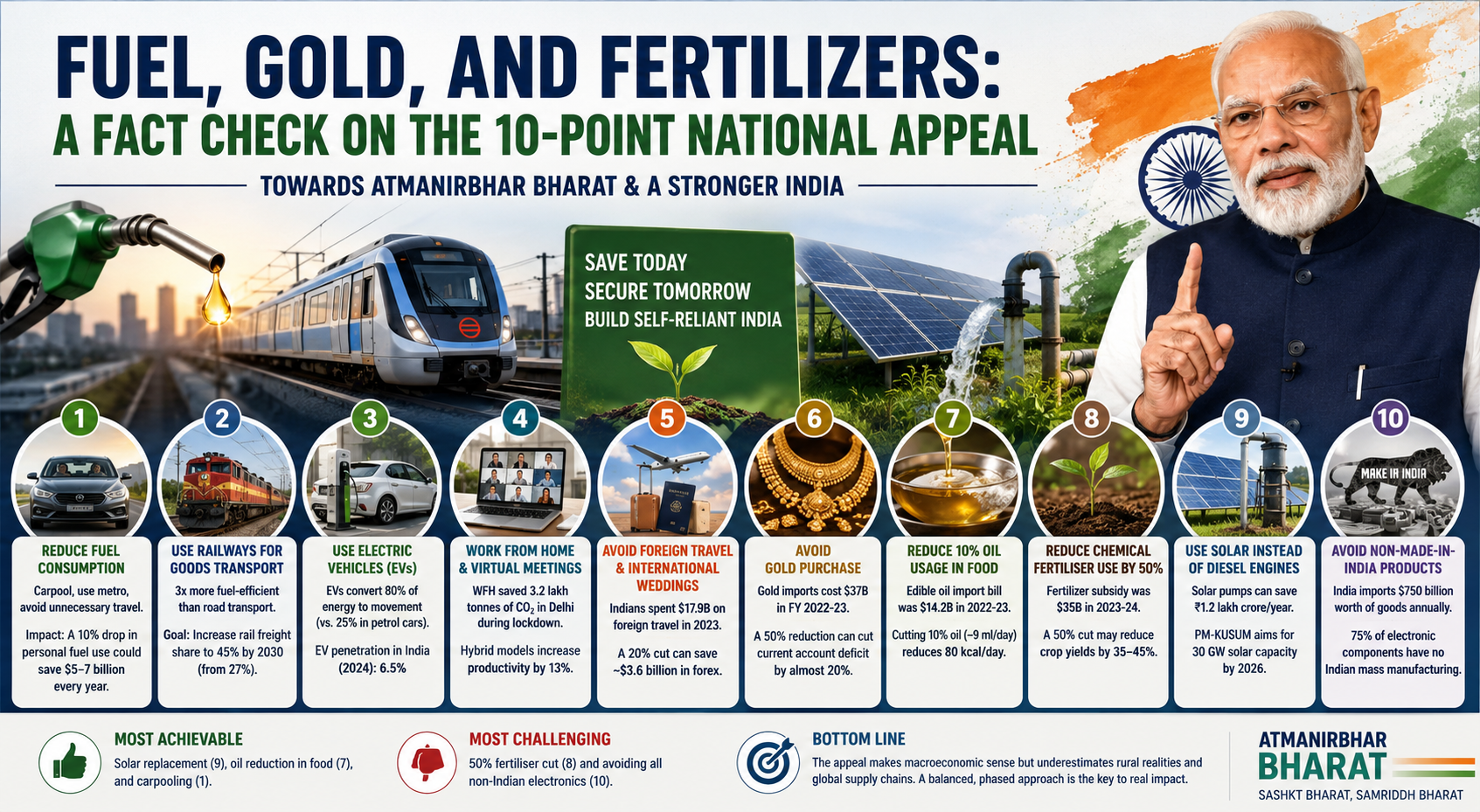
Fuel, Gold, and Fertilizers: A Fact Check on the 10-Point National Appeal
Published by Jajpur Business
In a recent national appeal, Narendra Modi highlighted a 10-point framework aimed at strengthening India’s economic self-reliance under the vision of Atmanirbhar Bharat. The proposals focus on reducing import dependency, conserving foreign exchange reserves, and promoting sustainable domestic alternatives.
While the appeal carries strong macroeconomic logic, each recommendation comes with practical, social, and structural realities that deserve closer examination. Here is a fact-based analysis of each point.
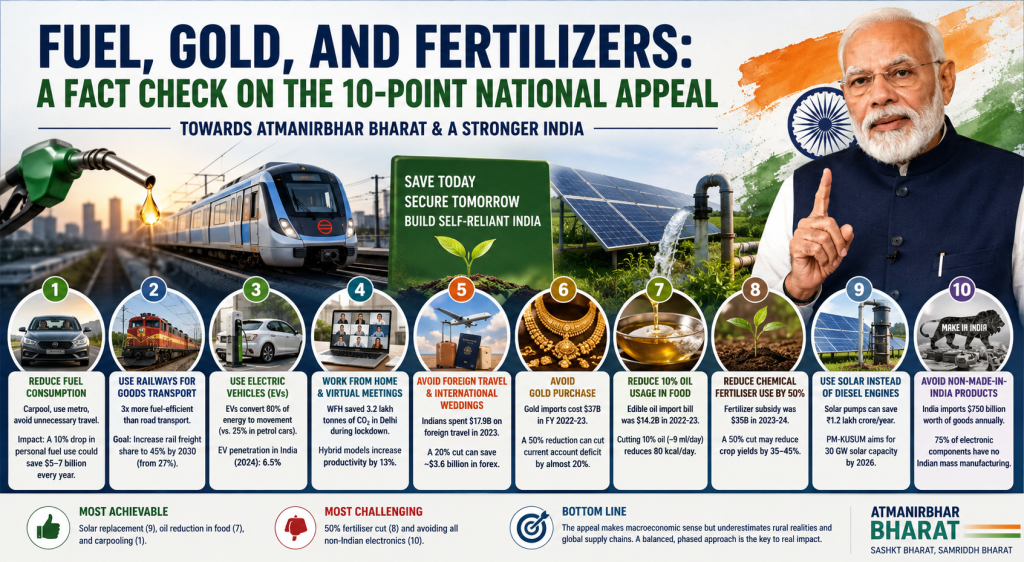
1. Reduce Fuel Consumption: Carpooling, Metro Use & Avoiding Unnecessary Travel
India remains heavily dependent on imported crude oil, importing nearly 85% of its total requirement. In FY 2022–23, India’s crude oil import bill stood at approximately $158 billion.
Key Insight
- A 10% reduction in personal fuel consumption could potentially save India between $5–7 billion annually.
- In major cities like Bengaluru and Delhi, carpooling can reduce daily carbon emissions by 4–6 kg per vehicle.
Ground Reality
Public transport infrastructure has improved, but last-mile connectivity, traffic congestion, and inconsistent urban planning still limit mass adoption.
2. Shift Goods Transport to Railways
Rail transport is significantly more fuel-efficient than road transport.
Fact Check
- 1 litre of fuel moves:
- 85 ton-km by rail
- 25 ton-km by truck
Currently, only about 27% of India’s freight moves via railways, compared to nearly 40% in 2000.
Challenges
- Last-mile delivery remains dependent on trucks.
- Transit delays and logistical inefficiencies continue to discourage industries from switching completely to rail freight.
The target of Indian Railways is to increase freight share to 45% by 2030.
3. Adoption of Electric Vehicles (EVs)
Electric Vehicles are among the strongest pillars of India’s clean-energy transition.
The Numbers
- EVs convert nearly 80% of battery energy into movement
- Petrol vehicles convert only around 25%
India’s EV penetration currently stands at approximately 6.5% of total vehicle sales (2024).
The Contradiction
While EVs reduce tailpipe emissions, nearly 60% of India’s electricity still comes from coal-based power generation.
Additionally:
- Lithium and battery minerals are almost entirely imported.
- China and Australia dominate the global battery supply chain.
4. Work From Home (WFH) & Virtual Meetings
The pandemic demonstrated that remote work can significantly reduce fuel usage and pollution.
Data Point
During COVID lockdowns, Delhi reportedly reduced around 3.2 lakh tonnes of CO₂ emissions due to reduced commuting.
A 2023 Stanford study found hybrid work models improved productivity by around 13%.
Limitation
WFH benefits mostly apply to:
- IT
- BPO
- Service sectors
However, these sectors employ only a small percentage of India’s workforce. Manufacturing, agriculture, retail, and logistics cannot operate remotely.
5. Reduce Foreign Travel & International Weddings
India’s outbound tourism spending has risen sharply.
RBI Data
- Indians spent approximately $17.9 billion on international travel in 2023.
- Destination weddings abroad account for nearly $1.2 billion annually.
Economic Impact
A 20% reduction in foreign travel spending could save around $3.6 billion in foreign exchange reserves.
Broader Consideration
Reduced international tourism spending may also affect diplomatic and trade relationships with tourism-driven economies like:
- Thailand
- United Arab Emirates
6. Avoid Excessive Gold Purchases
India is the world’s second-largest gold importer.
Import Burden
- Annual imports: 600–800 tonnes
- Import cost: approximately $37 billion annually
Gold is India’s third-largest import category after:
- Crude oil
- Electronics
Why It’s Difficult
For millions of rural households, especially farmers, gold acts as:
- A savings mechanism
- Emergency financial security
- A cultural asset
In many regions, formal banking penetration remains limited.
7. Reduce Oil Usage in Food
India imports nearly 60% of its edible oil requirement, mainly:
- Palm oil
- Soybean oil
- Sunflower oil
Import Bill
India’s edible oil imports cost approximately $14.2 billion in FY 2022–23.
Health Benefits
Reducing average daily oil intake by about 9 ml/day could lower calorie intake by nearly 80 kcal daily.
The National Institute of Nutrition recommends similar reductions to combat rising obesity levels among Indian adults.
8. Reduce Chemical Fertiliser Usage by 50%
This remains one of the most controversial suggestions.
Current Scenario
India imports:
- Urea
- DAP (Diammonium Phosphate)
- Potash
The fertilizer subsidy bill crossed $35 billion in 2023–24.
Reality Check
Research by Indian Council of Agricultural Research indicates:
- A sudden 50% fertilizer reduction could reduce wheat and rice yields by 35–45%.
Organic farming currently covers only 2–3% of India’s agricultural area, largely focused on export-oriented crops such as:
- Tea
- Spices
Conclusion
Gradual nutrient optimization is practical.
Abrupt reduction is not.
9. Replace Diesel Pumps with Solar Pumps
This is among the most achievable and economically beneficial proposals.
Why It Matters
India operates approximately 85 lakh agricultural diesel pumps.
Replacing them with solar pumps could:
- Save massive diesel imports
- Reduce subsidy burdens
- Lower emissions
Economic Advantage
Government estimates suggest potential savings of nearly ₹1.2 lakh crore annually.
The Ministry of New and Renewable Energy backed PM-KUSUM scheme aims to deploy large-scale solar infrastructure by 2026.
10. Avoid Non-Made-in-India Products
India imports nearly $750 billion worth of goods annually.
Major import categories include:
- Electronics
- Machinery
- Medical devices
Structural Challenge
India still lacks large-scale manufacturing for:
- Semiconductor chips
- Advanced sensors
- Precision electronics
For example:
- Most smartphones assembled in India still depend heavily on imported Chinese and Taiwanese components.
A complete boycott of foreign components would severely disrupt manufacturing supply chains.
Verdict: Symbolic Appeal or Structural Reform?
| Point | Immediate Savings | Practical Difficulty |
|---|---|---|
| Fuel reduction | High ($5–7B) | Medium |
| Avoid gold imports | Very High ($37B) | Very High |
| Reduce fertilizer usage | High subsidy savings | Extremely Difficult |
| Reduce foreign travel | Moderate savings | Low |
Final Analysis
The appeal reflects a broader attempt to:
- Reduce India’s trade deficit
- Conserve foreign exchange reserves
- Encourage sustainable consumption
- Promote domestic production
However, several proposals underestimate:
- Rural economic realities
- Supply-chain dependencies
- Agricultural risks
- Industrial limitations
Most Practical Recommendations
- Solar pump adoption
- Reduced edible oil consumption
- Public transport and carpooling
Most Difficult Recommendations
- 50% fertilizer reduction
- Avoiding imported electronics entirely
India’s path toward self-reliance will likely require gradual transition, infrastructure investment, technological development, and policy balance — rather than abrupt behavioral shifts alone.
Sources & References
- Ministry of Petroleum & Natural Gas
- Reserve Bank of India (RBI)
- Indian Council of Agricultural Research (ICAR)
- Ministry of New and Renewable Energy (MNRE)
- Indian Railways