

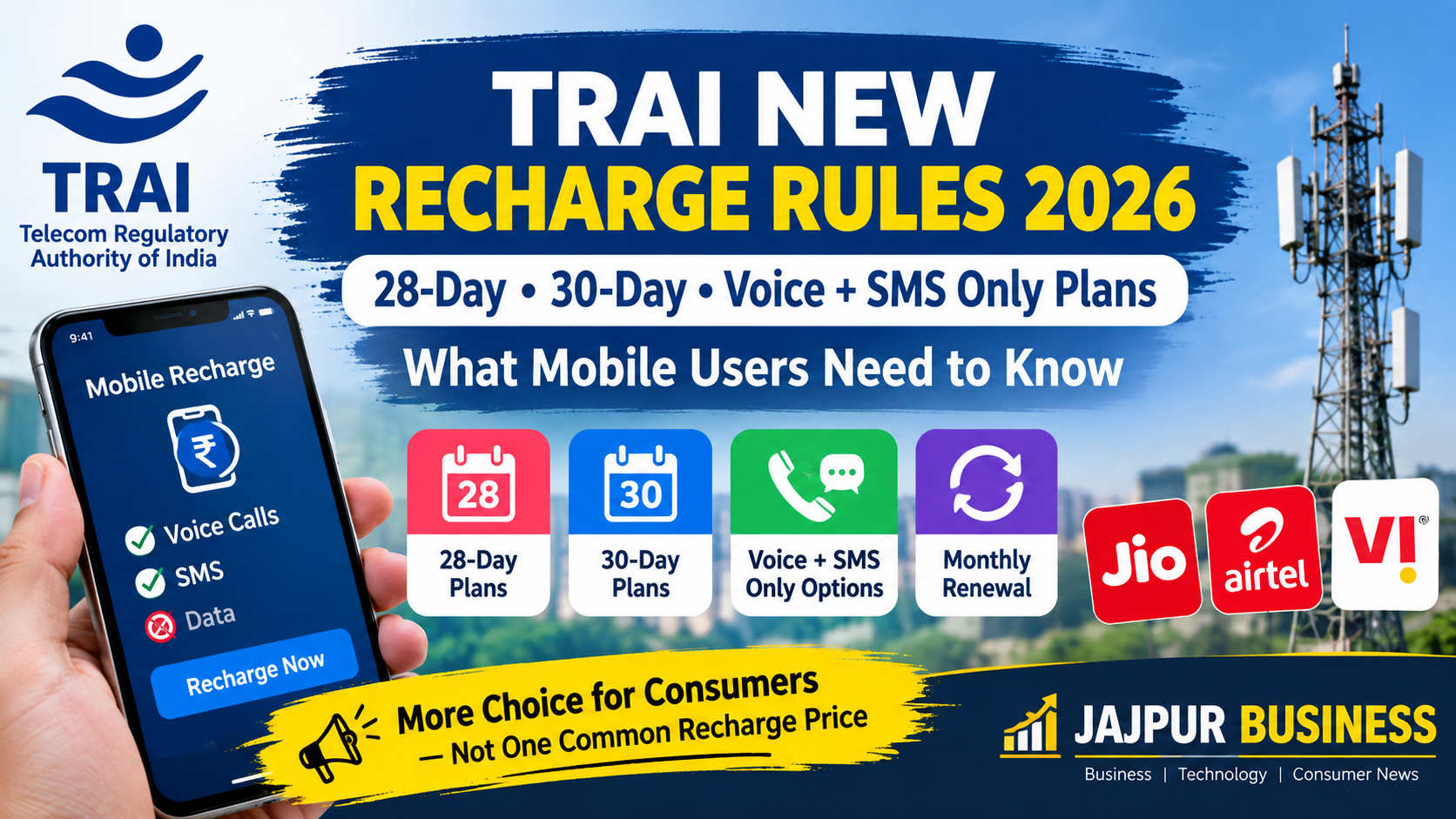
TRAI New Recharge Rules 2026: What Changed in 28-Day and 30-Day Mobile Plans?
Special Business & Consumer Report | Jajpur Business
New Delhi | September 29, 2026
The Telecom Regulatory Authority of India (TRAI) has introduced a new consumer-protection framework aimed at giving prepaid mobile users more choice, particularly those who use their phones mainly for voice calls and SMS and do not need mobile data.
TRAI released the Telecom Consumers Protection (Thirteenth Amendment) Regulations, 2026 in September 2026. The regulator says the change addresses the limited availability of shorter-duration Voice-and-SMS-only Special Tariff Vouchers (STVs), which had largely been concentrated around longer validity periods.
The development has generated considerable discussion among mobile users about 28-day, 30-day and monthly recharge plans.
But what exactly has changed?
What Is the New TRAI Rule?
Under the new framework, telecom service providers must provide corresponding Voice-and-SMS-only STVs with an appropriate reduction in tariff for certain validity periods.
The requirement covers:
- Each 30-day and shorter validity period offered for a Voice, SMS and data STV
- A plan that can be renewed on the same date every month
- At least one Voice-and-SMS-only STV with a longer validity corresponding to qualifying Voice, SMS and data STVs
TRAI says these provisions are intended to give consumers more flexibility and allow them to choose a recharge according to their requirements and financial capacity.
Does This Mean Every 28-Day Plan Will Become 30 Days?
No.
This is one of the most important points for consumers to understand.
The new regulation does not mean that every existing 28-day recharge automatically becomes a 30-day recharge.
Instead, where an operator offers a particular validity period under its Voice, SMS and data STV structure, the rules require a corresponding Voice-and-SMS-only option.
Therefore, consumers should check the actual recharge plans offered by their telecom operator rather than assuming that every existing plan has been converted.
What Is a Voice-and-SMS-Only Recharge?
A Voice-and-SMS-only pack is a prepaid plan that provides:
Voice calling + SMS
but does not include mobile data.
TRAI says these plans are intended for people who do not require internet services and want to use their mobile connection primarily for calls and messages. TRAI’s consumer information page states that Voice-and-SMS-only plans can have validity periods of up to 365 days.
This can be particularly relevant for users who have limited internet requirements or use Wi-Fi for most online activities.
Why Has TRAI Introduced the Change?
TRAI’s explanation focuses on consumer choice.
Following the earlier 2024 framework, the regulator observed that only a limited number of Voice-and-SMS-only STVs were being offered, with many concentrated around longer validity periods.
According to TRAI, this limited the availability of shorter-duration options for consumers, particularly those seeking more affordable recharge choices.
The regulator therefore conducted a consultation process before finalising the 2026 amendment.
TRAI said it received 1,132 stakeholder responses and also held an Open House Discussion on June 15, 2026, before finalising the regulations.
What About 30-Day Recharge Plans?
The 30-day issue has received significant attention because consumers often compare a 28-day recharge with a calendar-month cycle.
Under the new rules, if a telecom operator offers a Voice, SMS and data STV with a 30-day validity, it must also provide a corresponding Voice-and-SMS-only STV with an appropriate tariff reduction.
There is also a requirement for a monthly-renewable option.
The monthly option is designed so that the validity can renew on the same date of every month. If that date does not exist in a particular month, the renewal date becomes the last date of that month.
This is different from simply saying that every recharge will have a 30-day validity.
Will Recharge Prices Become Cheaper?
The new regulations do not establish one common nationwide recharge price.
Instead, the rules require appropriate tariff reductions for the corresponding Voice-and-SMS-only STVs.
The actual price will continue to depend on the tariff plans offered by individual telecom service providers.
Therefore, customers should not assume that every prepaid recharge will automatically become cheaper.
The benefit is primarily that consumers should have more plan choices without data when the corresponding validity options are offered.
Who Could Benefit From These Rules?
The new framework could be relevant to several categories of mobile users.
Senior Citizens
Many senior citizens primarily use their mobile phones for calls and occasional SMS. A voice-and-SMS-only option may allow them to avoid paying for data they do not need.
Feature-Phone Users
Users with basic or feature phones may have little use for mobile data. Voice-and-SMS-only plans can provide a more suitable alternative.
Secondary SIM Users
Some people maintain a second mobile number for business, banking, emergency communication or other purposes. A voice-only plan may be useful where regular data usage is not required.
Low-Data Users
Even smartphone users may prefer a voice-and-SMS-only recharge if they normally use Wi-Fi or another connection for internet access.
What Does This Mean for Jio, Airtel and Vi Customers?
Customers of major telecom operators such as Jio, Airtel and Vodafone Idea (Vi) should check the recharge options available through their respective official apps, websites and authorised retail channels.
The TRAI regulation establishes requirements concerning the availability of certain types of tariff vouchers. It does not announce one identical recharge price for every telecom company.
Therefore, customers should compare the actual plans available from their operator.
Before completing a recharge, check:
1. Recharge price
2. Validity
3. Voice benefits
4. SMS benefits
5. Data included or excluded
6. Monthly renewal conditions
7. Additional benefits, if any
28 Days vs 30 Days: What Consumers Should Know
The debate around 28-day and 30-day plans is not simply about changing a number.
A 28-day validity means a recharge generally expires after 28 days, while a 30-day plan provides a 30-day validity.
The new TRAI framework does not state that all operators must eliminate 28-day plans.
Instead, it requires corresponding Voice-and-SMS-only options for validity periods of 30 days and less when those validity periods are offered for Voice, SMS and data STVs.
So, consumers should look at the actual validity displayed during recharge rather than relying on social-media claims.
Important: Do Not Confuse the Draft With the Final Rule
TRAI first released a draft of the Thirteenth Amendment in April 2026 for consultation.
The draft proposed addressing the availability of shorter-duration Voice-and-SMS-only packs. TRAI subsequently considered stakeholder responses and finalised the regulation in September.
Therefore, news reports or social-media posts based only on the April draft may not fully explain the final provisions.
What Consumers Should Do Now
Mobile users do not need to change their SIM cards or immediately switch operators because of these rules.
Instead, consumers should:
- Check their operator’s current prepaid plans.
- Compare 28-day and 30-day validity where available.
- Look for Voice-and-SMS-only options.
- Check whether a monthly-renewal plan is available.
- Confirm the total benefits before paying.
- Avoid forwarding unverified recharge-related messages.
The regulator’s official consumer information also provides details about Voice-and-SMS-only packs.
Jajpur Business Consumer Alert
For mobile users in Jajpur, Jajpur Road and across Odisha, the main takeaway is simple:
TRAI has expanded the type of prepaid Voice-and-SMS-only options that telecom operators must provide.
However, this should not be interpreted as meaning that every 28-day recharge has automatically become a 30-day recharge, or that every mobile recharge price has been reduced.
The actual plan, price and validity will depend on the telecom operator’s tariff offerings within the regulatory framework.
Consumers should therefore check the official recharge page or app of their operator before making a payment.
Final Takeaway
The 2026 TRAI amendment is primarily about consumer choice.
Users who need mobile data can continue choosing data-inclusive plans. Users who primarily need calling and SMS should have access to more suitable Voice-and-SMS-only alternatives corresponding to relevant validity periods.
The new framework specifically covers 30-day and shorter validity periods, a same-date monthly-renewal option, and longer-validity corresponding options.
So the headline message for consumers is:
More Recharge Choices — Not One Common Recharge Price
Before believing a viral message about “28-day recharge ending” or “all plans becoming 30 days,” consumers should check the actual tariff offered by their telecom operator.
Jajpur Business will continue to track telecom, digital payment, technology and consumer-business developments and provide verified updates.
Source: Telecom Regulatory Authority of India (TRAI), Telecom Consumers Protection (13th Amendment) Regulations, 2026 and TRAI consumer information on Voice-and-SMS-only packs.
Published by: Jajpur Business
Category: Business • Technology • Consumer News
Suggested Featured Image Text:
TRAI NEW RECHARGE RULES 2026
28-Day • 30-Day • Voice + SMS Only Plans
What Mobile Users Need to Know