

Below is a Jajpur Business–style special report, updated with the latest official clarification from the Ministry of Finance.
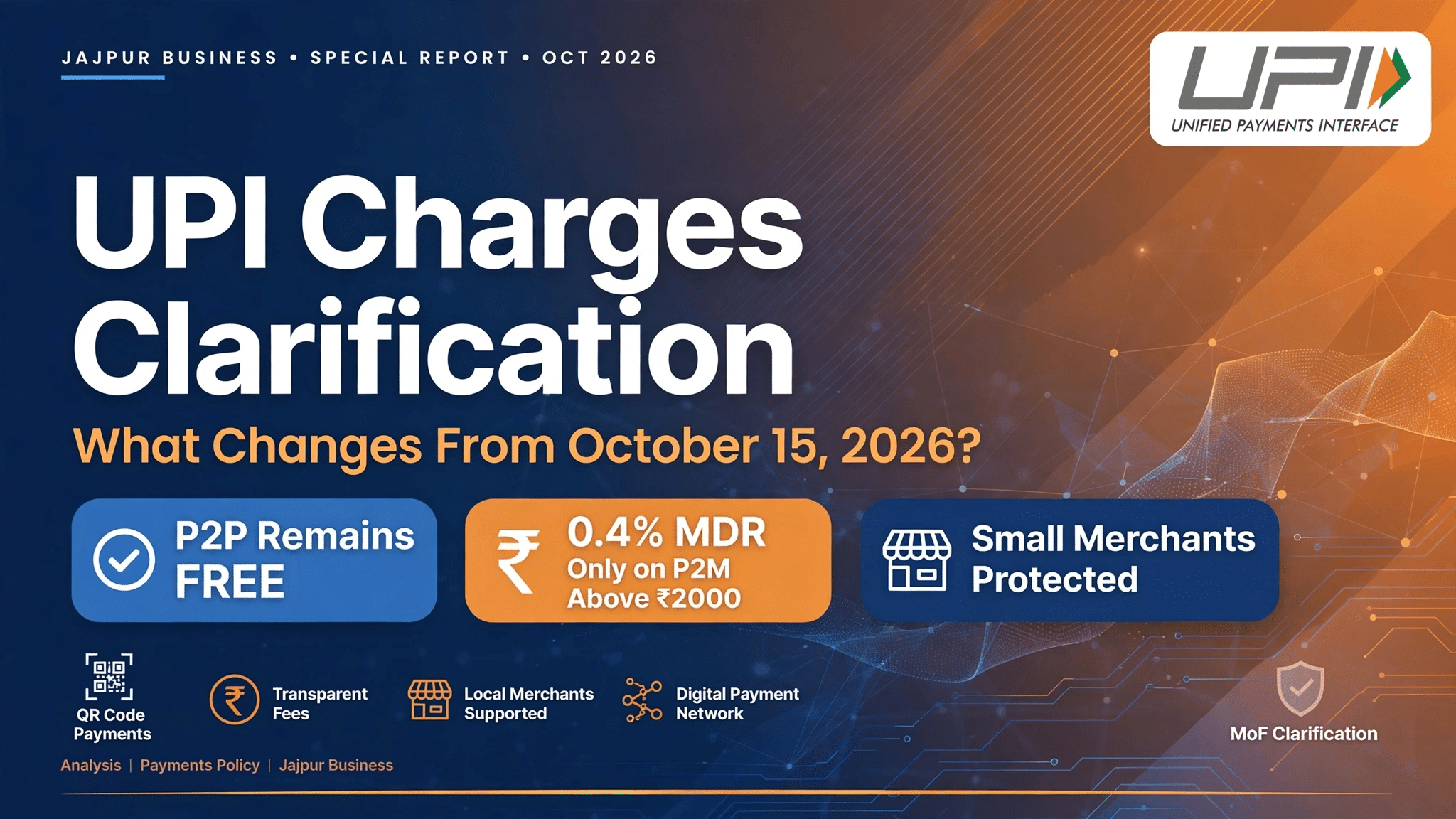
UPI Charges Clarification: What Changes From October 15, 2026?
Special Report | Jajpur Business
Jajpur, Odisha | September 16, 2026
India’s digital payment ecosystem is set to undergo an important change from October 15, 2026, with the introduction of a Merchant Discount Rate (MDR) on certain high-value UPI payments made to merchants.
However, the development has also created confusion among UPI users, with messages circulating on social media suggesting that people will have to pay a new charge whenever they use UPI.
The official clarification is important: ordinary person-to-person UPI transactions will remain completely free.
The Ministry of Finance has stated that the new framework will not impose charges on individuals sending or receiving money through UPI. The new MDR applies only to specified person-to-merchant (P2M) transactions above ₹2,000.
What Is MDR?
MDR stands for Merchant Discount Rate. It is a fee within the payment ecosystem associated with accepting certain merchant payments.
According to the Ministry of Finance, MDR is not a government tax and is not a direct charge collected from customers. The amount is distributed among participants in the payment ecosystem, including banks and payment service providers.
Will You Pay a UPI Charge?
For ordinary users, the answer is no under the new framework.
If you send money to a friend, family member or another individual, the transaction remains free regardless of the amount.
For example:
- Sending ₹5,000 to a friend — No UPI charge
- Sending ₹20,000 to a family member — No UPI charge
- Receiving money from another person — No UPI charge
- Paying a merchant up to ₹2,000 — No MDR
- Certain merchant payments above ₹2,000 — MDR may apply within the payment ecosystem
The government has also stated that banks should ensure merchants do not pass the MDR cost on to customers.
What Happens to Merchant Payments Above ₹2,000?
Under the new framework, a 0.4% MDR will apply to specified person-to-merchant UPI transactions above ₹2,000.
For transactions of ₹75,000 and above, the MDR will be capped at ₹300 per transaction.
This means the change is primarily relevant to businesses and the payment ecosystem rather than ordinary person-to-person transfers.
Small Shops and Street Vendors Protected
One of the important provisions concerns small merchants.
According to the Ministry of Finance, small merchants receiving up to ₹1 lakh per month through UPI QR codes under the P2PM category will continue to receive the benefit of zero MDR on their transactions.
This provision is intended to protect street vendors, neighbourhood shops and other small businesses from additional payment costs.
For small businesses in places such as Jajpur, Jajpur Road, Korei and surrounding rural markets, this distinction is particularly important because many local businesses increasingly depend on QR-code payments.
What About Essential Services?
The new framework also specifies different treatment for certain essential and thin-margin sectors.
For eligible transactions above ₹2,000 in sectors including railways, telecommunications, insurance, fuel and agricultural inputs, the reported MDR is a flat ₹5 per transaction.
Capital-market related payments, including certain mutual fund, securities, stockbroker and dealer transactions, have a separate MDR rate of 0.02%, subject to a ₹300 cap.
Around 96% of Merchant Transactions Unaffected
The Ministry of Finance says the change will affect only about 4% of merchant transactions.
Consequently, approximately 96% of P2M transactions will remain unaffected, either because they are below the ₹2,000 threshold or because they fall under the zero-MDR framework for small merchants.
This is why the headline “UPI will now charge everyone 0.4%” does not accurately describe the new framework.
Why Is This Change Being Introduced?
The government has described the framework as part of an effort to support the long-term sustainability of India’s UPI ecosystem.
UPI has become a major part of India’s digital economy, and maintaining payment infrastructure requires continued investment in technology, security, banking systems and payment services.
The new framework therefore introduces MDR for a limited category of larger merchant transactions while retaining free P2P payments and protecting many small merchants.
What Should UPI Users Remember?
The most important points are simple:
1. P2P UPI remains free.
2. Customers are not supposed to pay MDR.
3. UPI merchant payments up to ₹2,000 remain free of MDR.
4. Specified merchant transactions above ₹2,000 can attract 0.4% MDR.
5. MDR is capped at ₹300 for transactions of ₹75,000 and above.
6. Eligible small merchants can continue under the zero-MDR framework.
7. MDR is not a new GST or government tax on every UPI payment.
8. Users should not believe or forward unverified social-media messages claiming that every UPI transaction will now be charged.
What Does This Mean for Jajpur’s Digital Economy?
UPI has become an important payment method for local retailers, service providers, travel operators, restaurants, small businesses, professionals and street vendors.
For customers, the latest clarification means that there is no blanket new UPI transaction fee.
For businesses accepting UPI, however, it is important to understand whether their transactions fall within the specified MDR categories and whether they qualify for the zero-MDR provisions applicable to small merchants.
Business owners should therefore check their bank or payment-service-provider communication before changing their QR payment practices or adding any additional payment charge.
Jajpur Business Clarification
The key message for customers is:
Don’t panic over social-media messages claiming that UPI has become chargeable for everyone.
The official framework distinguishes between person-to-person payments and specified merchant payments.
From October 15, 2026, the revised MDR framework will apply to specified merchant transactions, while ordinary P2P UPI payments continue to remain free.
Jajpur Business advises readers to verify payment-related information through official sources such as the Ministry of Finance, NPCI and their respective banks before acting on viral messages.
Source: Ministry of Finance, Government of India — UPI clarification dated September 15, 2026.
Published by: Jajpur Business
Special Report | Digital Payments & Business
